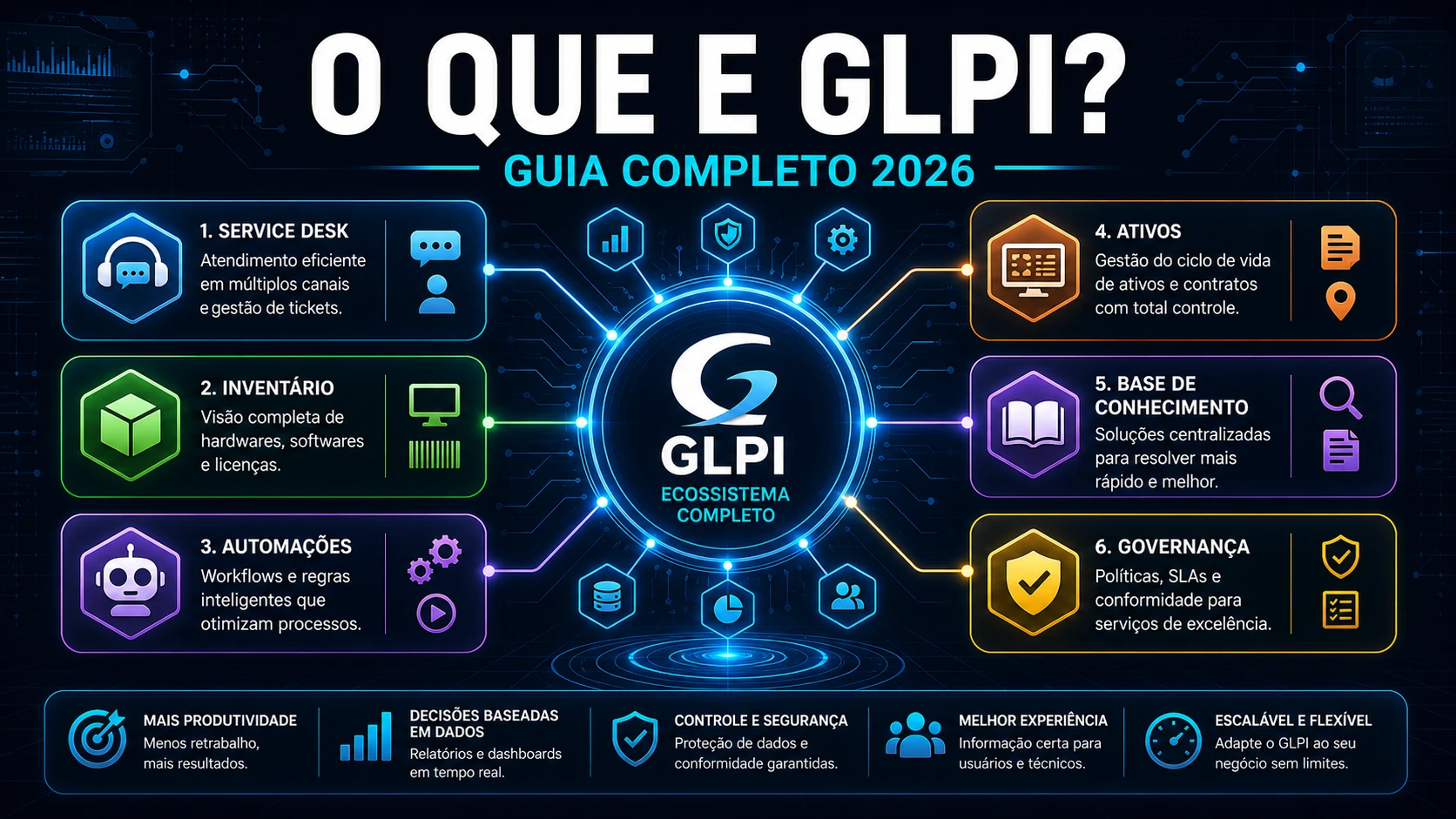
GLPI is one of the most widely used open source ITSM tools in the world, but its true potential only shows when you combine the core with plugins and modules that fill specific gaps. In this guide we have gathered the 50 most relevant plugins and modules for 2026, blending open source community solutions with modules from the NexTool ecosystem.
The list is organized by category. For each item, you will find what it does, who it is meant for and a direct link to the official page or repository.
Solutions HUB
1. NexTool
Type: Modular plugin (FREE + licensed modules) · GLPI: 10 and 11
NexTool is not a standalone plugin — it is a platform that turns GLPI into an expandable hub. From a single free base plugin, you activate modules on demand: AI, communication, documents, security, automation and more. The catalog grows every month without you having to install dozens of separate plugins, manage dependencies or deal with version conflicts. If you are looking for a centralized, professional approach to expanding GLPI, NexTool is the starting point.

AI and Intelligent Automation
2. AI Assist
Type: NexTool (Free) · View module
Integrates OpenAI GPT and Google Gemini directly into the ticket. With one click, the technician gets a summary of long threads and receives reply suggestions drafted from the history. Ideal for teams that want to reduce response time without upfront investment — the module is 100% free.


3. Smart Assign
Type: NexTool (Free) · View module
Automatically distributes tickets among the technicians of the responsible group, using workload balancing. Eliminates the need for manual assignment and ensures no technician is overloaded while others sit idle.

4. Automations
Type: NexTool (Licensed) · View module
Automation engine that lets you configure webhooks, conditional actions and integrations with external systems without writing code. When a ticket changes status, the module can trigger notifications, create records or call third-party APIs.

5. Behaviors
Type: Community (Free) · GitHub
Lightweight plugin that adds simple automations to GLPI: automatic group assignment when opening a ticket, enforcing required fields and ID numbering. A good option for those who need basic rules without complexity.
Inventory and Assets
6. GLPI Inventory
Type: Native (GLPI 10+) · Official site
As of GLPI 10, hardware and software inventory became native. The GLPI Agent collects information from workstations, servers and network devices without the need for an additional plugin. If you are on GLPI 10 or 11, this is the recommended solution.
7. Geolocation
Type: NexTool (Licensed) · View module
Adds geographic coordinates to assets and tickets, displaying interactive maps inside GLPI. Useful for teams that manage assets spread across multiple locations and need geographic visibility.
8. Stock Management
Type: NexTool (Licensed) · View module
Stock control integrated into the ticket: links items (parts, components, consumables) directly to the ticket, with quantity, batch and movement history control.


9. FusionInventory
Type: Community (Free) · GitHub
The best-known inventory plugin in the GLPI ecosystem, with more than 360 stars on GitHub. Automatic collection of hardware, software, printers, monitors and SNMP devices. Although GLPI 10+ already offers native inventory, FusionInventory remains a reference for GLPI 9.x environments and migrations.
10. OCSInventory NG
Type: Community (Free) · GitHub
Integration with OCS Inventory NG to automatically sync the GLPI CMDB. Lets you import assets inventoried by OCS, keeping GLPI as the central management console.
11. GenericObject
Type: Community (Free) · GitHub
Lets you create new custom inventory object types, integrated into the GLPI framework. Useful for managing items that do not fit the native types.
Note: Compatible with GLPI 9 and 10. In GLPI 11, the custom objects feature was incorporated natively into the core.
Ticket Flow and Approval
12. Escalade
Type: Community (Free) · GitHub
Makes it easier to escalate tickets between support groups. When a technician transfers the ticket to another group, the plugin can automatically remove the previous group and keep the escalation history visible. Simple and efficient for operations with multiple support levels.
13. Ticket Flow
Type: NexTool (Licensed) · View module
Visual ticket flows with conditional rules. Defines sequences of automatic actions that run as the ticket progresses — ideal for standardizing complex support processes.

14. Approval Flow
Type: NexTool (Licensed) · View module
Multi-level approval escalation with conditional routes. Configures chains of approvers by category, entity or request type, with automatic notifications at each step.

15. Problem Flow
Type: NexTool (Licensed) · View module
Extends GLPI problem management with automated flows. Links recurring incidents to problems, makes root cause analysis easier and tracks the implementation of corrective changes.
16. SubTask Flow
Type: NexTool (Licensed) · View module
Creates subtask hierarchies within tickets, letting you break complex requests into smaller steps with independent owners and deadlines.
17. MetaDemands
Type: Community (Free) · GitHub
Lets you create complex requests that involve multiple areas in a single multi-step form. Each step generates specific tickets for the responsible groups, keeping the original request traceable.
Service Catalog
18. FormCreator
Type: Community (Free) · GitHub
The most popular plugin in the GLPI ecosystem, with more than 180 stars on GitHub. It turns ticket creation into a guided experience: custom forms with conditional fields, approval flows and an accessible service catalog. Indispensable for teams that serve non-technical users.
Note: Compatible with GLPI 9 and 10. In GLPI 11, customizable forms were incorporated natively into the core, with an integrated visual interface.
Communication and Notifications
19. WhatsApp Bot
Type: NexTool (Free) · View module
Sends ticket notifications and requests approvals directly through WhatsApp. The user receives a quick action link and can approve, reject or comment without opening GLPI. For teams whose main communication channel is WhatsApp, this module removes the barrier between GLPI and daily work.


20. Telegram Bot
Type: NexTool (Licensed) · View module
The same concept as the WhatsApp Bot, adapted for Telegram. Instant notifications, inline approvals and automatic linking between GLPI users and Telegram chat IDs.
21. Smart Notify
Type: NexTool (Free) · View module
Smart notifications filtered by profile, avoiding the flood of emails GLPI generates by default. Each user receives only what is relevant to their role, on the channels they prefer.

22. Mail Interactions
Type: NexTool (Licensed) · View module
Turns email replies into structured follow-ups on the ticket, with smart handling of CCs, duplicates and forwarding chains. Ideal for teams where the communication flow still goes mostly through email.

23. Mail Analyzer
Type: NexTool (Free) · View module
Automatically analyzes and routes emails received by GLPI, identifying duplicates, blocking unnecessary CC chains and deciding whether an email should generate a new ticket or a follow-up on an existing one.

Documents and Reports
24. Order Service
Type: NexTool (Licensed) · View module
Generates professional service orders in PDF from tickets, with a customizable template, requester data, service description and a signature field. For companies that need formal documentation of each service call.

25. Autentique
Type: NexTool (Licensed) · View module
Integration with the Autentique platform for electronic signature of documents generated in GLPI. The document is automatically sent for signing and the status is updated on the ticket.

26. Signature Pad
Type: NexTool (Licensed) · View module
Allows manual signature capture (touch or mouse) directly on the GLPI ticket. The signature is embedded into the service order PDF, eliminating the need for paper.
27. PDF
Type: Community (Free) · GitHub
Simple plugin that lets you export any GLPI item to PDF, selecting which tabs to include in the document. Useful for generating quick reports of tickets, assets or contracts.
28. DataInjection
Type: Community (Free) · GitHub
Lets you bulk import data into GLPI from CSV files. Essential during initial implementations or migrations, when you need to populate the CMDB with hundreds of assets at once.
29. Reports
Type: Community (Free) · GitHub
Adds pre-formatted reports that do not exist in native GLPI: tickets by category, by technician, by period, assets by location and more. A quick alternative for those who do not want to set up external BI.
30. MReporting
Type: Community (Free) · GitHub
Takes GLPI reports to another level with interactive charts: bar, line, pie and area. Generates visual dashboards directly in GLPI, without depending on external tools like Metabase or Grafana.
31. Metabase Integration
Type: Community (Free) · GitHub
For those who already use Metabase, this plugin embeds dashboards directly into GLPI pages, syncing the data model and enumerations automatically.
Time and Contracts
32. Contract Hours
Type: NexTool (Licensed) · View module
Timer integrated into the ticket with billing by contract. The technician starts, pauses and ends the count with one click. The module automatically calculates the hours consumed per contract and generates consumption reports by period.
33. ActualTime
Type: Community (Free) · GitHub
Time tracking plugin developed by TICGAL. Adds start/pause/stop buttons to tasks, recording the actual time spent — not the estimated one. Ideal for teams that need precise effort metrics.
34. TimelineTicket
Type: Community (Free) · GitHub
Displays a visual timeline of the ticket lifecycle: when it was opened, assigned, escalated, resolved and closed. Makes it easier to analyze bottlenecks in the support flow.
Security and Access Control
35. Access Matrix RBAC
Type: NexTool (Licensed) · View module
Visual matrix of CRUD permissions by profile and by module. Lets you audit and adjust granular permissions without navigating through dozens of GLPI screens. Essential for environments with multiple profiles and compliance requirements.
36. CVE Scan
Type: NexTool (Free) · View module
Checks for known vulnerabilities (CVEs) in the software inventoried in GLPI. Cross-references the asset base with public vulnerability databases and displays alerts directly on the asset panel.


37. Accounts
Type: Community (Free) · GitHub
Manages accounts and access credentials for third-party systems directly in GLPI. Lets you record users, passwords and access URLs linked to assets or entities, with permission control over who can view each credential.
38. MFA
Type: Community (TICGAL) · TICGAL
Adds multi-factor authentication to GLPI. Supports TOTP apps (Google Authenticator, Authy) as a second factor, protecting administrative accounts against unauthorized access.
39. GLPI SAML
Type: Community (Free) · GitHub
Single Sign-On via the SAML protocol with support for multiple Identity Providers (Azure AD, Okta, Keycloak). Creates users automatically on first login and applies Just-in-Time rules to assign profiles, groups and entities.
40. Passwords
Type: Community (TICGAL) · TICGAL
Password manager integrated into GLPI. Stores credentials in encrypted form, with access control by profile and a history of changes. A practical alternative for teams that still use spreadsheets to store passwords.
Organization and User Experience
41. Fields
Type: Community (Free) · GitHub
The second most popular plugin in the ecosystem (110 stars on GitHub). Lets you add custom fields to any type of GLPI item — tickets, assets, users, contracts. Indispensable for tailoring GLPI to your organization's specific processes.
42. Tag
Type: Community (Free) · GitHub
Creates colored labels that can be linked to any GLPI item. Allows cross-cutting categorizations — for example, marking tickets as “VIP”, “Business-Urgent” or “Auditable” — with native filters for search.
43. Branding
Type: NexTool (Free) · View module
Customizes the GLPI appearance with your company's visual identity: logo, colors, browser title and footer. Turns generic GLPI into a tool that looks like your organization.
44. Column Resize
Type: NexTool (Free) · View module
Lets you resize columns in GLPI listings by dragging the border. Preferences saved per user. A small UX improvement that makes a difference in the daily work of those who deal with dense listings.
45. GLPI Bug Fixes
Type: NexTool (Free) · View module
Centralizes visual and behavioral fixes for known GLPI bugs, without editing the source code. Each fix can be enabled or disabled individually. The first available fix removes the visual clutter of category codes in dropdowns.
46. Rule Inspector
Type: NexTool (Free) · View module
Debugs GLPI business rules with full transparency. Displays a detailed log of each evaluation: which criteria were tested, which passed and which failed. An essential tool for administrators who configure complex rules.

47. Ticket Tracker
Type: NexTool (Free) · View module
Automatically tracks who viewed each ticket, how many times and when. A dedicated tab on the ticket displays the full access history — useful for auditing and for knowing whether the owner has already seen the ticket.
48. Pending Survey
Type: NexTool (Free) · View module
Manages pending satisfaction surveys, showing reminders and making it easier to track which tickets are still awaiting user evaluation. Increases the survey response rate in a non-intrusive way.


Project Management
49. Gantt
Type: Community (Free) · GitHub
Adds Gantt chart visualization for GLPI projects. Lets you track tasks, dependencies and deadlines visually, making it easier to plan IT projects and migrations.
50. Agile PM
Type: Community (TICGAL) · TICGAL
Agile project management integrated into GLPI, with a Kanban board, sprints and backlog. Ideal for IT teams that adopt agile methodologies and want to consolidate project and ticket management in the same tool.
Next step
You do not need to implement them all at once. Start with the ones that solve the most urgent pains of your operation and expand as the environment matures.
If you are looking for a centralized approach, NexTool is the fastest path: a single base plugin gives access to more than 25 modules, with no dependency conflicts or compatibility problems between third-party plugins. Talk to the team for a demonstration.
This content was produced with the aid of artificial intelligence and reviewed by the Nextool Solutions team. The plugins listed were verified for availability and compatibility in May 2026.